The combination of terms “limited mobility” is pretty much self explanatory. And most of the time it leads to a not too physically active life for most of us, which is so bad for our health. The good news is that there are tons of sports designed for people with limited mobility, and depending on the way your limbs are affected, you should have enough choices. It’s a great way to pass the time, it will improve your health and it will give you a sense of achievement, making you feel more independent, it will reduce your stress level by making your brain release more endorphins, it will reduce the pain and many more awesome benefits. Who knows, maybe we will even see you at the Olympics! So let’s take a look at 3 of the most well known options. Hopefully this post will help you decide what you should start with.
1. Paralympic Swimming

As the name states, it is a sport governed by the International Paralympic Committee, so it’s also part of the Paralymic games. But of course, it can be practiced by anyone and at any level (starting with beginner, of course). Physical disabilities of Paralympic swimmers include single or multiple limb loss (through birth defects and/or amputation),cerebral palsy, spinal cord injuries (leading to paralysis or disability in limb coordination), dwarfism, and disabilities which impair the use of joints. So if you think this is the right sport for you, stop wondering how you’ll manage to not drown due to the limited mobility of your limbs, and start looking for a place where you can safely practice it. Swimming is great! And you’ll be less scared of boat rides too!
Famous athlete: Eleanor May Simmonds (photo), is a British Paralympian swimmer competing in S6 events. She came to national attention when she competed in the 2008 Summer Paralympics in Beijing, winning two gold medals for Great Britain, despite being the youngest member of the team, at the age of 13. In 2012 she was again selected for the Great Britain squad, this time swimming at a home games in London. She won another two golds in London, including setting a World Record in the 400m freestyle.
2. Wheelchair racing

We have marathons, car racing, motorbike racing… so why not wheelchair racing? Even though the racing wheelchair may look slightly different from what you’re used with… but if you’re bound to use one and think that your arms and spirit are strong enough for the competition, why not look into it? Wheelchair racing is open to athletes with any qualifying type of disability, amputees, spinal cord injuries, cerebral palsy and partially sighted (when combined with another disability). Athletes are classified in accordance with the nature and severity of their disability or combinations of disabilities. Like running, it can take place on a track or as a road race. The main competitions take place at the Summer Paralympicswhich wheelchair racing and athletics has been a part of since 1960. Competitors compete in specialized wheelchairs which allow the athletes to reach speeds of 30 km/h or more. It is one of the most prominent forms of Paralympic athletics.
Famous athlete: David Russell Weir (photo), CBE (born 5 June 1979) is a British Paralympic wheelchair athlete. He has won a total of six gold medals at the 2008 and 2012 Paralympic Games, and has won the London Marathon on six occasions. He was born with a spinal cord transection that left him unable to use his legs.
3. Wheelchair Basketball

If you’re a fan of basketball and wish that you could practice it, there actually is a version of it which can be practiced by people in wheelchairs. The rules are pretty much the same and it is as dynamic as you would expect basketball to be. Wheelchair basketball sees tremendous competition and interest on the international level. Wheelchair basketball is included in the Paralympic Games. The Wheelchair Basketball World Championship is organized two years after every Paralympic Games. Major competition in wheelchair basketball comes from Canada, Australia, the United States, Great Britain, the Netherlands, and Japan.
Famous Athlete: Ade Adepitan (photo) MBE (born 27 March 1973) is a British television presenter and wheelchair basketball player. He uses a wheelchair as a result of contracting polio as a child which led to the loss of use of his left leg. Adeptitan is an accomplished wheelchair basketball player, for his club Milton Keynes Aces and as a member of Great Britain team that won the bronze medal at the 2004 Summer Paralympics in Athens and the gold medal at the 2005 Paralympic World Cup in Manchester, United Kingdom.
1. Paralympic Swimming
As the name states, it is a sport governed by the International Paralympic Committee, so it’s also part of the Paralymic games. But of course, it can be practiced by anyone and at any level (starting with beginner, of course). Physical disabilities of Paralympic swimmers include single or multiple limb loss (through birth defects and/or amputation),cerebral palsy, spinal cord injuries (leading to paralysis or disability in limb coordination), dwarfism, and disabilities which impair the use of joints. So if you think this is the right sport for you, stop wondering how you’ll manage to not drown due to the limited mobility of your limbs, and start looking for a place where you can safely practice it. Swimming is great! And you’ll be less scared of boat rides too!
Famous athlete: Eleanor May Simmonds (photo), is a British Paralympian swimmer competing in S6 events. She came to national attention when she competed in the 2008 Summer Paralympics in Beijing, winning two gold medals for Great Britain, despite being the youngest member of the team, at the age of 13. In 2012 she was again selected for the Great Britain squad, this time swimming at a home games in London. She won another two golds in London, including setting a World Record in the 400m freestyle.
2. Wheelchair racing
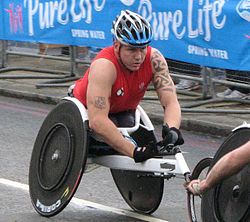
We have marathons, car racing, motorbike racing… so why not wheelchair racing? Even though the racing wheelchair may look slightly different from what you’re used with… but if you’re bound to use one and think that your arms and spirit are strong enough for the competition, why not look into it? Wheelchair racing is open to athletes with any qualifying type of disability, amputees, spinal cord injuries, cerebral palsy and partially sighted (when combined with another disability). Athletes are classified in accordance with the nature and severity of their disability or combinations of disabilities. Like running, it can take place on a track or as a road race. The main competitions take place at the Summer Paralympicswhich wheelchair racing and athletics has been a part of since 1960. Competitors compete in specialized wheelchairs which allow the athletes to reach speeds of 30 km/h or more. It is one of the most prominent forms of Paralympic athletics.
Famous athlete: David Russell Weir (photo), CBE (born 5 June 1979) is a British Paralympic wheelchair athlete. He has won a total of six gold medals at the 2008 and 2012 Paralympic Games, and has won the London Marathon on six occasions. He was born with a spinal cord transection that left him unable to use his legs.
3. Wheelchair Basketball
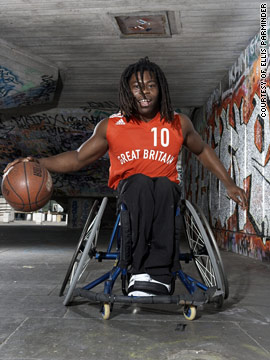
If you’re a fan of basketball and wish that you could practice it, there actually is a version of it which can be practiced by people in wheelchairs. The rules are pretty much the same and it is as dynamic as you would expect basketball to be. Wheelchair basketball sees tremendous competition and interest on the international level. Wheelchair basketball is included in the Paralympic Games. The Wheelchair Basketball World Championship is organized two years after every Paralympic Games. Major competition in wheelchair basketball comes from Canada, Australia, the United States, Great Britain, the Netherlands, and Japan.
Famous Athlete: Ade Adepitan (photo) MBE (born 27 March 1973) is a British television presenter and wheelchair basketball player. He uses a wheelchair as a result of contracting polio as a child which led to the loss of use of his left leg. Adeptitan is an accomplished wheelchair basketball player, for his club Milton Keynes Aces and as a member of Great Britain team that won the bronze medal at the 2004 Summer Paralympics in Athens and the gold medal at the 2005 Paralympic World Cup in Manchester, United Kingdom.
 0
comments
0
comments



.jpg)